I visited the video installation Îles flottantes (If Monet Met Cézanne, in Montfavet), at Instituto Moreira Salles, by Scottish artist Douglas Gordon (1966), who also has an exhibition at Galeria Marília Razuk in São Paulo, and discussed it in my column Ouvir Imagenson Rádio USP on April 23.
In this video installation, shown only once before, in France in 2008, video becomes painting and painting enters into dialogue with the audiovisual. It reveals two recurring features of Douglas Gordon’s work: references to great masters of art history and an investigation of the image in its many formats and languages.
Douglas Gordon became internationally known through 24 Hour Psycho(1993), in which he slowed down Hitchcock’s famous Psycho until it became a 24-hour work. By extending this suspense classic across an entire day, Gordon singled out themes that would become defining features of his work: the viewer’s memory and the limits of perception. He not only reconstructed its meaning through a new temporal arrangement, but confronted viewers with levels of detail imperceptible at its normal speed.
Other famous video installations include Between Darkness and Light (After William Blake) (1997), in which he projected two films about girls manipulated by hidden forces on opposite sides of a semitransparent screen: The Exorcist (1973) and The Song of Bernadette (1943); and Play Dead; Real Time (2003), in which Minnie, a circus elephant, walked around in large projections, lay down as if dead, and got up again. To round things off, he co-directed with Philippe Parreno the feature film Zidane, filmed with 17 simultaneous cameras in a stadium, and participated in the 29th São Paulo Biennial with Pretty Much Every Film, a kind of archive-installation presenting 82 videos on a collection of 100 cathode-ray-tube monitors. It was no accident that Douglas Gordon made history as the first artist to receive the prestigious Turner Prize for a video installation.
 Play Dead; Real Time (2003) – Tate and National Galleries of Scotland. © Douglas Gordon.
In this particular work, Îles flottantes, as the project’s curator in Brazil, Professor Lorenzo Mammì, points out, Douglas Gordon juxtaposes the work of two painters, Paul Cézanne (1839–1906) and Claude Monet (1840–1926), creating a field of tension between the transparent reflections of the flooded garden characteristic of Monet and the volumes and concentrated light characteristic of Cézanne.

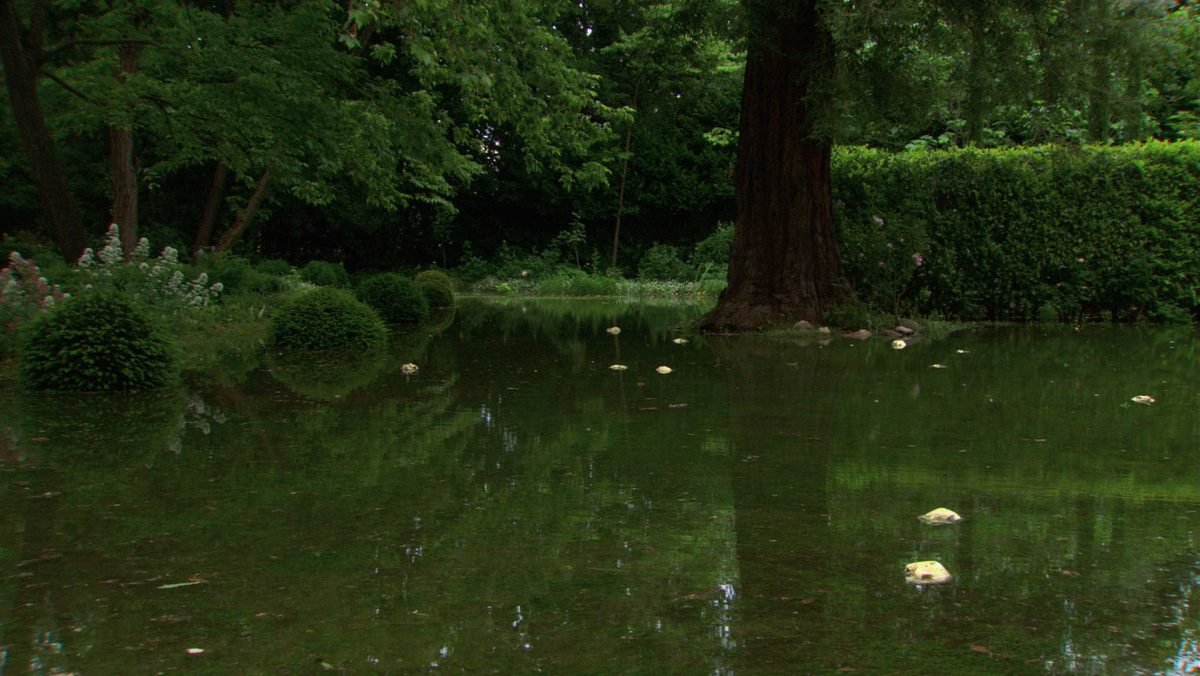 Images from Douglas Gordon’s video installation Îles flottantes (If Monet Met Cézanne, in Montfavet), 2008 © Studio lost but found / VG Bild-Kunst, Bonn 2018
But another procedure here deserves attention: the cross-contamination of Impressionist painting and video. This struck me strongly in the projection. Movements are almost imperceptible, far subtler than in an Impressionist painting. Now and then something moves, and suddenly we discover a new way of looking at video: as if it were painting. And vice versa.
Douglas Gordon
Îles flottantes at IMS Paulista
I will, if you will… (Douglas Gordon exhibition at Galeria Marília Razuk)
Transcript of the weekly Ouvir Imagens column, broadcast by Rádio USP.
Access the playlist in the Rádio USP archive.
Previous texts.
Listen to this column: