In my first column of the year for Revista ZUM, I analyze the construction of President Bolsonaro’s image, from the amateur aesthetic of his campaign to his governmental image. I discuss its visual rhetoric and how it fits into a new imaginary of official history shaped on and by social networks.
___________
“Feicebuqui, Feicebuqui, Whatizape, Whatizape!!!” [Facebook, Facebook, WhatsApp, WhatsApp!!!] With this greeting, unprecedented at any presidential inauguration, demonstrators welcomed the press to the Esplanade of Ministries in Brasília on January 1, 2019. The greeting suited the style of the new officeholder, Jair Messias Bolsonaro. On his social networks, the president makes clear that they were not merely a means of reaching power. More than vehicles of personal communication, the networks are his principal institutional channel and the site where his image is constructed. That image is the language in which the official history of his government is being written.
With some 24 million followers across his Twitter, Facebook, Instagram and YouTube accounts, the 38th president of the Republic is the Latin American politician with the most digital allies. This is the result of meticulous, committed work, carried out with keyboards and cameras that traveled through the most varied settings during his presidential campaign: from offices to living rooms, via the kitchen, his backyard barbecue, the ATM and even his ICU bed while hospitalized.
The picture is completed by numerous livestreams, a Facebook feature for broadcasting video in real time. These live addresses strengthen a visual regime that has made all the difference to the rules of the political game in which President Bolsonaro plays a leading role. The images that dominate his appearances are makeshift, sometimes out of focus, shot with poorly positioned cameras, careless lighting and distorted angles.
In these videos, the background often features a menorah on one side—the Jewish candelabrum that also forms part of Evangelical liturgy—and a clay water jug on the other, such an unassuming symbol of Brazilian culture. On the table are assorted objects: papers with notes, receipts, books by and/or about British politician Winston Churchill, anti-Marxist treatises and various phones. What sets the tone is a certain general untidiness, with the look of an improvised set, a constant feature of these recordings.
Amateur aesthetics
This revives the amateur aesthetic consolidated by the appropriation of home-video language, which exploded with YouTube and emerges as a strategy for getting closer to the “real world.” Discussed in depth by critics such as Ilana Feldman and Felipe Polydoro, this aesthetic seeks to oppose the technically perfect imagery of Hollywood’s (or Rede Globo’s) standard of quality by suppressing mediation. As if the image produced were a direct tracing of reality, without any interference from the media that produce it or the people who put them to use. The effectiveness of the amateur aesthetic lies in this idealized opposition.
One of the most-viewed videos on his busy YouTube channel shows Bolsonaro speaking by mobile phone to the crowd on Avenida Paulista on the eve of the first round of voting. In it, all the observations made so far are pushed to their limit. His face in shadow, backlit, with far-from-impressive oratory, in a video recorded standing in the garden while trying to see the images being shown to him on another phone, the then candidate sent his voters into raptures.
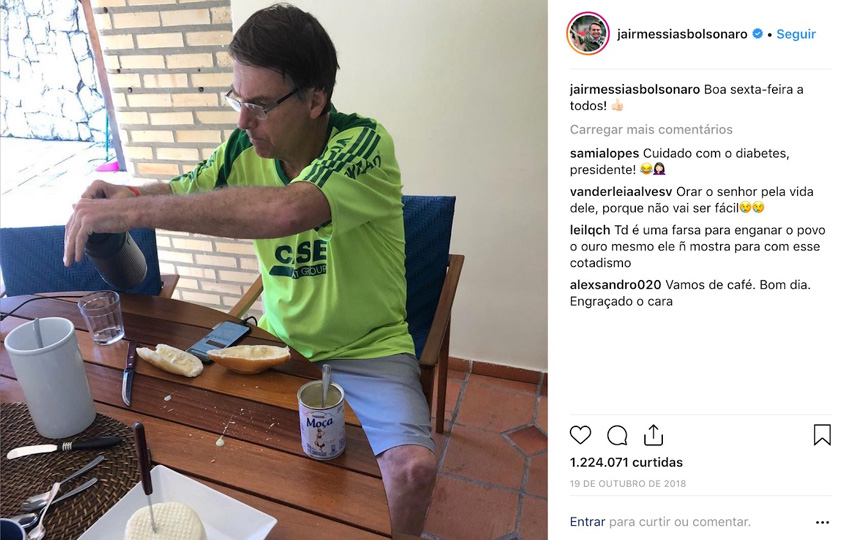
In front of his own cameras, Bolsonaro laughs, turns serious, challenges “the media,” prepares his breakfast bread with condensed milk, goes to the butcher and cooks a barbecue, appears at the barber’s, poses with his daughter, rests on the sofa and shares gifts received from anonymous followers. In a sports shirt and shorts, or even in a suit and tie, already serving as president, he does not speak to his voter: he expresses him. And in expressing him, as Roland Barthes wrote when discussing electoral photogenics in his book Mythologies, he turns him into a hero, inviting the voter to elect himself.
Continue reading