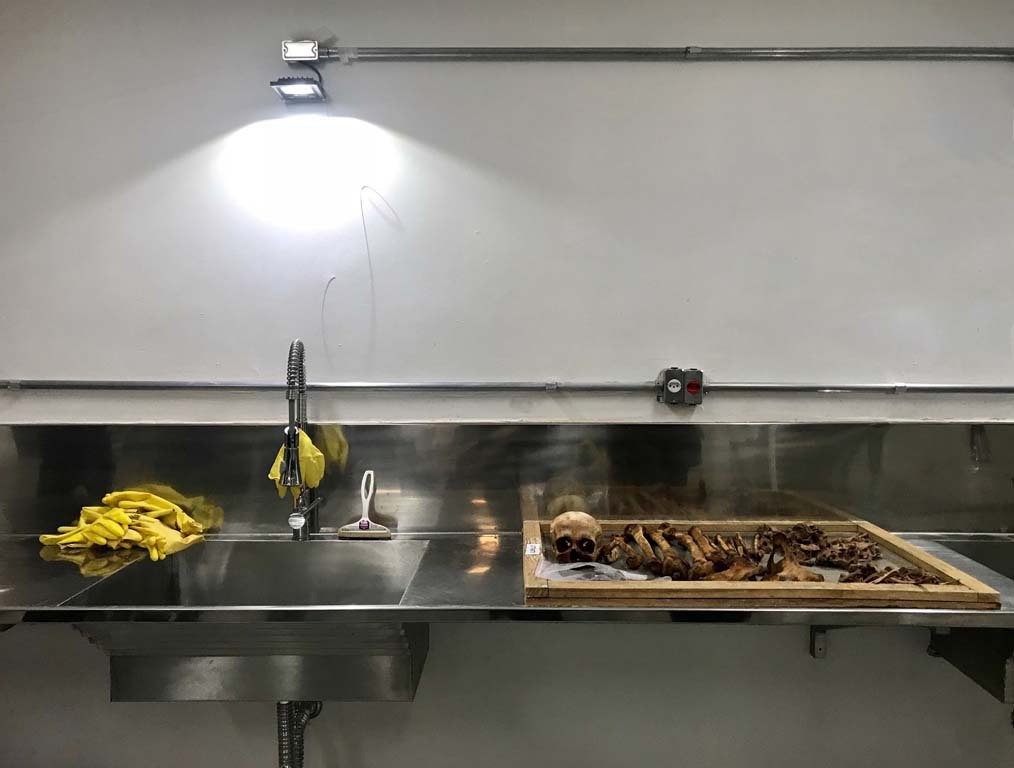
A photographic essay and sound narrative tell the story of the human remains from the clandestine mass grave at Dom Bosco Cemetery (Perus).
Work commissioned for the exhibition Meta-arquivo (1964–1985)
2019
The installation Gavetas de Ossos combines sound and photographs, discussing architecture and the methods of the anatomist and detective in the field of memory, as well as the life stories stolen by the Brazilian dictatorship of 1964. It grew out of a visit to Unifesp’s Center for Forensic Anthropology and Archaeology (Caaf), undertaken as part of a course taught at FAU-USP with Renato Cymbalista on sites of memory of the Brazilian dictatorship. Established in 2014, Caaf is an interdisciplinary center devoted to developing scientific protocols for identifying victims of institutional repression in Brazil. One of its central projects[1] is the working group on the “Perus Mass Grave.”
Discovered in 1990 at Dom Bosco Cemetery in the Perus neighborhood, the grave contained 1,047 sets of human remains of victims of the Brazilian dictatorship buried there clandestinely. Without artistic intent, the photographs were taken “at point-blank range,” in the urge to record an unusual situation: How can we make the bodies of those denied a life story speak? How can we deal with plastic boxes that document the machinery erasing the memory of struggles for freedom? How can we honor the meticulous work of those seeking to undo the disconcerting proximity between drawers of bones and drawers of documents?
[1] On April 11, 2019, President Jair Bolsonaro signed Decree 9,759, which “abolishes and establishes guidelines, rules, and limitations” for councils, groups, and commissions of the federal public administration. Although it does not abolish the Perus Mass Grave working group, the decree makes its continuation unviable, a matter still under discussion at the time of writing. See <planalto.gov.br/ccivil_03/_ato2019-2022/2019/decreto/D9759.htm>establishes guidelines, rules, and limitations” for councils, groups, and commissions of the federal public administration. Although it does not abolish the Perus Mass Grave working group, the decree makes its continuation unviable, a matter still under discussion at the time of writing. See <planalto.gov.br/ccivil_03/_ato2019-2022/2019/decreto/D9759.htm>


