ART
MEIAC creates an online art viewer to preserve digital works
The NETescopio project launches with the exhibition “Desmontajes” — The Extremadura museum has acquired several computer-generated works or works based on computer languages and components
R. BOSCO / S. CALDANA January 15, 2009
“net.art requires a new approach to museums, very different from the accumulation and safekeeping of physical works characteristic of the nineteenth-century museum. We must overcome the fetishism of static collections, focus on the idea of the archive, and preserve not only the works but also the ideas that gave rise to them.”
“net.art requires a new approach to museums, very different from the accumulation and safekeeping of physical works characteristic of the nineteenth-century museum. We must overcome the fetishism of static collections, focus on the idea of the archive, and preserve not only the works but also the ideas that gave rise to them,” says Antonio Franco, director of the Museo Extremeño e Iberoamericano de Arte Contemporáneo (MEIAC) in Badajoz, a pioneer in acquiring digital art.
Almost ten years after investing in immaterial art as a way of achieving a central position independent of geography, Franco has launched a new project. It is NETescopio, an online art viewer and continuously developing archive designed to preserve works conceived for the Internet, recovering and rescuing them from oblivion when necessary. “The nature of net.art works and the Internet’s constantly evolving architecture require dynamic cataloging and documentation strategies that take advantage of the medium’s characteristics,” Franco explains.
More acquisitions
The director is also undertaking a redesign of MEIAC’s website, whose collection includes forty net.art works by thirty-six artists acquired by the museum over these years, ranging from 100 euros for simple pieces such as Out of the ordinary by Lisa Jevbratt to 7,000 euros for Artist’s statement Nº 45.730.944 by Young-hae Chang Heavy Industries.
MEIAC has acquired several works that are not strictly net.art, but are computer-generated or based on computer languages and components, such as Soliloquio by Konic Thtr; Struct_1 by André Sier; Every icon, by John F. Simon Jr.; Train by John Klima; and Figures and letters by Charles Sandison.
Not all of MEIAC’s works are part of NETescopio, since the idea is to expand the archive selectively. “We do not want the project to be limited to simply copying pieces onto a server. We want it to preserve the production environment and intellectual context through artist interviews, technical records, and critical analyses that offer interpretive keys and allow the public to explore the inner workings of Internet art.” To this end, Franco has entrusted the project’s initial phase to the Argentine Gustavo Romano, a visual artist and cultural organizer active in digital creation.
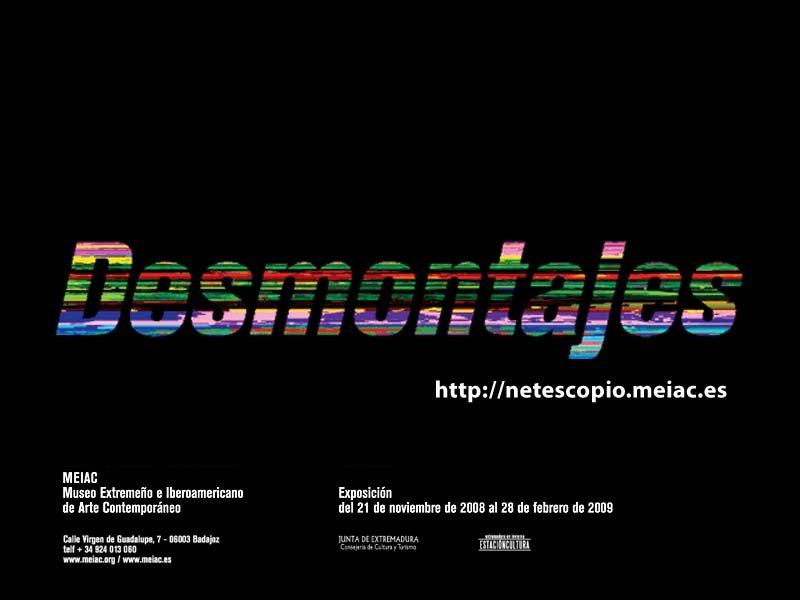
Desmontajes, his proposal for the launch of NETescopio, focuses on works produced in the web’s early years, demonstrating the eagerness to explore new forms of expression and the surprise online art pioneers experienced in the face of interactivity and alternative uses of computing.
The selection for Desmontajes includes thirty-one works divided into five sections: interfaces, stereotypes, narratives, everyday life, and the art system, each preceded by the word dismantling. There are works from around the world, with particular attention to the Ibero-American sphere. Eastern European artists, especially active in the early period of net.art, stand out.
In this case, these are not acquisitions but the digital equivalent of placing traditional works on deposit: the artist grants exhibition rights to the museum, which in exchange undertakes to keep the work active and in good condition and to promote its dissemination and study.
Each installment of NETescopio will be accompanied by a printed publication intended to expand information and critical reflection on the pieces. The initiative will continue to develop through selections by guest curators. To retain its open and dynamic character, however, both artists and enthusiasts can propose related works, which may be incorporated after the museum’s evaluation.
Works by Giselle Beiguelman in Netescopio: