An artistic intervention with wheatpaste posters recalls AI-5 and warns of the dangers of authoritarianism
Since the early hours of April 3, passersby in Largo da Batata, in Pinheiros, have seen a series of wheatpaste posters bearing phrases referring to Institutional Act No. 5. AI-5, whose enactment (December 13, 1968) turns 50 this year, marked the military dictatorship’s harshest period, granting rulers the power to arbitrarily punish anyone deemed an enemy or a threat to the regime.
April 3 was the eve of the Supreme Federal Court’s hearing of former president Lula’s habeas corpus petition. It was also the day Army commander General Eduardo Villas Bôas declared on Twitter that he rejected impunity and that the Army remained mindful of its institutional missions. The statement prompted immediate expressions of support from other generals on the same social network, a wave of protests online, in the Senate and from Justice Celso de Mello at the Supreme Court, and a statement of condemnation from Amnesty International.
This was the trigger that led artist Bianca Turner to go out before dawn to put up her series of wheatpaste posters. She developed the series during an artist residency in Germany last year, where she devoted part of her time to scrutinizing a Folha de S.Paulo special website dedicated to AI-5.
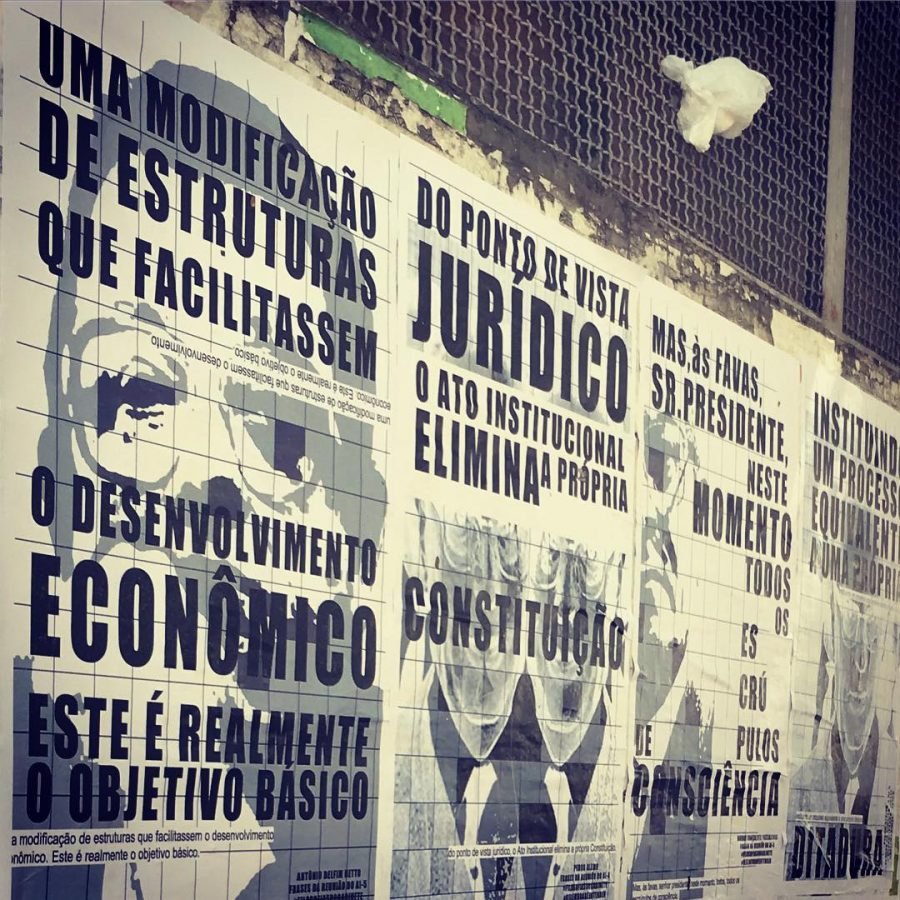 Bianca Turner’s wheatpaste posters use phrases from AI-5 and are part of the Filosofias do Gabinete project. #recordaréntender
The Folha website provides not only the audio recording and minutes of the National Security Council meeting at Laranjeiras Palace that decided to issue Institutional Act No. 5, but also its transcript. From these documents, Bianca selected the phrases that make up her 15 posters. The material remained stored away until General Eduardo Villas Bôas’s statements set the Internet ablaze.
All the phrases are deeply disturbing because they blur into statements currently circulating in confrontations online and in the streets about democracy, respect for the Constitution, the country’s interests and the fear of disorder.
They display sayings such as “Above one man’s will stand the national interest, harmony, tranquility and peace for the Brazilian people.” Or: “It is difficult to maintain order in the country with the Constitution alone.” And, to top it off: “To hell, Mr. President, at this moment, with all scruples of conscience.”
The names appear in much smaller letters. The first quotation, for example, is from General Arthur Costa e Silva, president under the military regime from 1967 to 1969. The second is from Magalhães Pinto, involved in the military coup since 1964, when he was governor of Minas Gerais, and minister of foreign affairs at the time of AI-5. The last is from the then minister of labor and social welfare, Jarbas Passarinho.
The project, called Filosofia dos Gabinetes, uses the phrase — or rather the hashtag — #relembraréentender (“remembering is understanding”) as its Instagram search key. I fully agree. Remembering is understanding.
Photos of the Filosofias do Gabinete project on Instagram
Folha de S.Paulo’s special website on AI-5
AI-5, by Maria Celina D’Araujo
Transcript of the weekly Ouvir Imagens column, broadcast on Rádio USP.
Access the playlist.
Previous texts.
Listen to this column: