Artist and professor Raimo Benedetti has just published a book with Editora Sesi-SP that is a gift to the eye: Entre Pássaros e Cavalos (Marey, Muybridge e o pré-cinema). With a foreword by ECA-USP professor Patricia Moran, the book begins with a coincidence: the birth date, 1830, and death date, 1904, of these two figures essential to understanding the history of cinema and contemporary photography.
French physiologist Etienne-Jules Marey invented chronophotography, a process of analyzing movement through successive photographs. English photographer Eadweard Muybridge, who settled in the United States, is the father of instantaneous and sequential photography. Muybridge’s series breaking down the movement of running horses are now famous online.
These series were made on the site of today’s Stanford University campus, named after its founder, who was Muybridge’s most important client.
Stanford’s motivation was economic. At the time, a horse’s gait was a source of information for building an engine and could answer key questions about mechanizing production. The aim was to capture the moment when all four hooves were in the air, the point of greatest power. This process is impossible to register with the naked eye, and photography was still extremely slow and manual, so Muybridge had to mechanize the procedure. To produce the series, he installed twelve cameras side by side to take sequential photographs.
These experiments by Muybridge inspired the scientist Marey to use the camera as a laboratory instrument. Marey was a physician, and his entire professional career was devoted to unraveling physiological movements such as breathing and muscular contractions.
Marey’s research was also connected to this world of optimizing work. One of his goals was to uncover the causes of fatigue and the traumatic impacts of muscular exertion, and to establish rules of posture and ergometric standards, many still used today.
Marey invented a device combining a clock mechanism and a camera mounted on a rifle, which he used for his famous bird series. It is considered a prototype of the motion-picture camera.
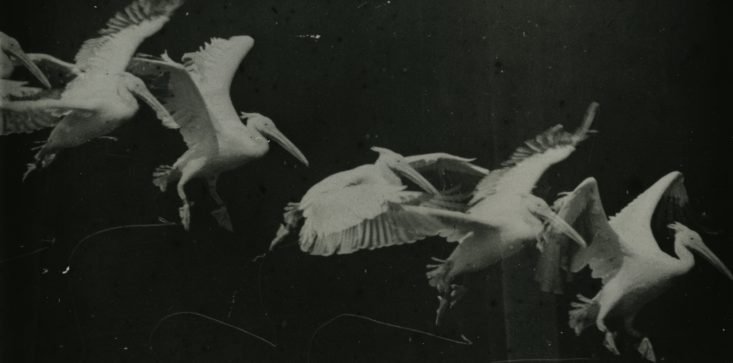 Photograph of pelicans in flight captured by Marey in 1882
Besides narrating the lives and work of Marey and Muybridge in parallel, and describing their meeting in Paris when both were fifty-one, the book is interspersed with numerous images and illustrations of nineteenth-century optical and kinetic devices.
A highlight of this publishing project is the accompanying series of interviews with curators and researchers, along with video records of the collections of specialist museums Raimo Benedetti visited while writing the book. All this material is accessible through QR codes distributed throughout the volume.
It is an essential work for understanding the history of technical images in their exchanges with industry and science—a history that leads to cinema, that decisive art of the visual experience of our time.
Transcript of Giselle Beiguelman’s Ouvir Imagens column, broadcast every Monday at 8 a.m. on Rádio USP (93.7).
Access the playlist with all audio episodes of the Ouvir Imagens column on Rádio USP | Read all the transcripts and posts.