From July 16 to September 25, 2016, Caixa Cultural São Paulo presented “Cinema Lascado,” a solo exhibition surveying the last ten years of my artistic production.
Curated by Eder Chiodetto, the exhibition includes video installations, projections and 22 previously unseen images, resulting from my research into digital images, the aesthetics of technological obsolescence and ruined urban landscapes.
From July 16 to September 25, Caixa Cultural presented Cinema Lascado (Chipped Cinema), a retrospective devoted to the last ten years of my work with digital images. Curated by Eder Chiodetto, the exhibition focuses on the aesthetics of obsolescence and fragmented urban landscapes.
Admission is free. Sponsored by Caixa Econômica Federal.
July 16–September 25. Caixa Cultural. Praça da Sé, São Paulo, SP.
The works:
Deserto Rosso (2016)
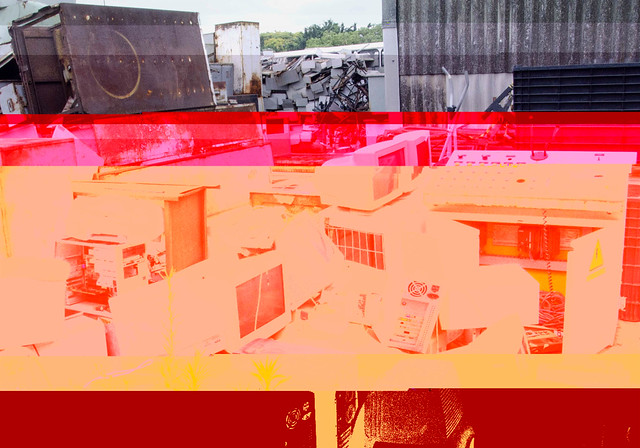
This previously unseen series references the film of the same name by Michelangelo Antonioni, one of Giselle Beiguelman’s main aesthetic influences. Shot at a municipal storage facility in São Paulo, the series portrays a scene that is a metaphor for the media landscape of the twenty-first century: state-of-the-art technologies turned into rubbish within a few years and piled up outdoors. It questions the disposability of digital equipment and its relationship with the inability to communicate, a central theme in Antonioni’s poetics.
This new series references the film of the same name by Italian filmmaker Michelangelo Antonioni, one of Giselle Beiguelman’s main aesthetic influences. The original photograph was taken at a storage facility in São Paulo, and the series portrays a scene that is a metaphor for the media landscape of the twenty-first century: state-of-the-art technology turned into rubbish within a few years and piled up outdoors. It questions the disposability of digital equipment and its relationship with the inability to communicate, a central theme in Antonioni’s poetics.
Paisagens Ruidosas (2013 – 2016)
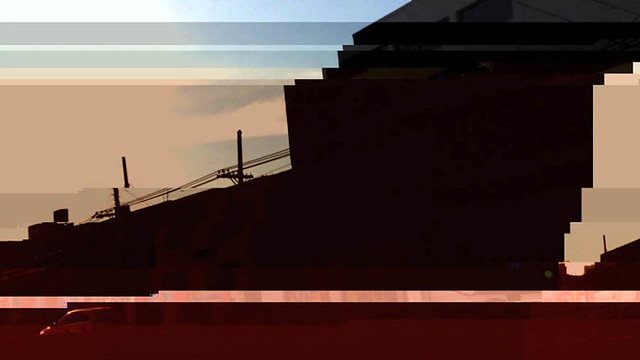
This series invites us to confront urban landscapes, taking disorder as the essential paradigm for experiencing them. The project explores the aesthetics of noise and obsolescence, particularly glitch, and the ways they engage with fragmented spaces and our experiences of urban ruins. The entire process, from capturing to editing the images, takes place on a mobile phone while in transit. The images are processed in all kinds of settings [airplanes, waiting rooms, taxis, while waiting for phone calls, etc.], using different apps. More.
This series invites us to confront urban landscapes, taking disorder as the essential paradigm for experiencing them. The project explores the aesthetics of noise and obsolescence, particularly glitch, and their dialogue with fragmented spaces and our experiences of urban ruins. The entire process, from image capture to editing, takes place on a mobile phone while in transit; the images are processed in a wide range of settings [airplanes, waiting rooms, taxis, while waiting for phone calls, etc.], using different apps. More.
CGH-SDU (Ode to the Minimal information), 2010

In this video, the landscape is reduced to its minimal informational elements—dominant colors and sound—turning movement into a flow of textures and volumes modulated by light. Recorded with a Flip video camera during takeoffs and landings between the urban airports of São Paulo (Congonhas, CGH) and Rio de Janeiro (Santos Dumont, SDU), on a day in July. Spoken in Portuguese and English. 05′05″. Portuguese, English.
Cinema Lascado: Minhocão (2010)
In Minhocão, the images unfold through a movement that scans the landscape, mixing high and low tech and combining high-definition video with animated GIF techniques. The result is a series of sequences that deconstruct space, which is then recreated as visual noise, driven by the dominant colors of the surroundings.
2′30″, two-channel video installation, loop, location sound [Collection of the Museum of Contemporary Art of the University of São Paulo, MAC-USP]
Cinema Lascado: Perimetral (2016)
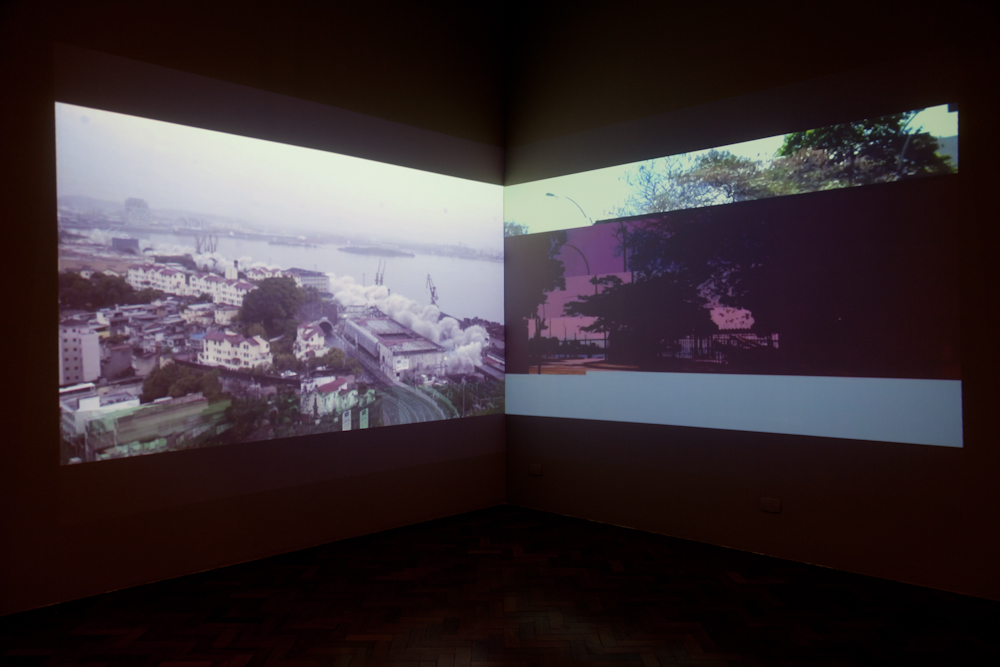
The Perimetral elevated highway was recorded from 2010 to 2015, before, during and after its implosion, with an emphasis on the redevelopment of Praça Mauá and the port district. Much of the footage was shot in areas of MAR [Museu de Arte do Rio de Janeiro] closed to the public, with the support of curator Clarissa Diniz. A trailer of the work was presented in 2013 at the X São Paulo Architecture Biennial, at the invitation of Guilherme Wisnik, with images from before the implosion. Completed in 2016, on the eve of the Olympics, the video installation asks: what do these images tell us about our urban scars and our ambivalence toward processes of modernization and metropolitan growth? What do they tell us about our tendency to forget and our desire to remember forever? What remains between gentrification and deterioration? The aesthetics of noise—and what else?
Fast/Slow_Scapes (2006)
Always filmed from inside vehicles [cars, taxis, boats, trains and buses], using different mobile phone models, the videos take viewpoints specific to the condition of the mobile camera’s “cyborg eye.” In this visual video diary, launched at Galeria Vermelho in São Paulo, the images seem walled in, as though they were still frames in motion. Each place was filmed from inside the means of transport that characterizes its territory: São Paulo by car, Berlin by train, Greece by boat, and so on. The different kinds of noise in these videos, now a decade old, arose from the mismatch in speed between the capture device [phones recording video at 16 frames per second] and the editing device [computers reading the files at 29.7 frames per second]. Seen retrospectively today, they recount not only the landscapes they portrayed, but also a history of audiovisual media in the age of technological nomadism.